The Parade of the Children

Parade of the Children San Miguel de Allende

Parade of the Children San Miguel de Allende

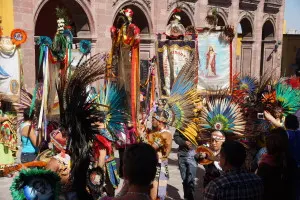
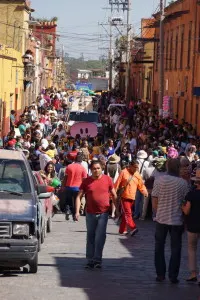
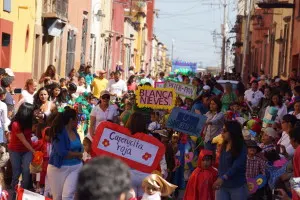
People in San Miguel take their festivals seriously so when some locals told me to be sure and catch the Desfile de los Niños (Parade of the Children), I knew it would be something special.

 Like almost all Mexican celebrations, this one has indigenous origins and is tied closely to the cycles of the Sun. The Parade of Children takes place approximately (mas o minus as they say around here) on the vernal equinox.

This is the day on the solar calendar (in case anyone needs reminding) when the Sun spends a brief moment in time directly above the Earth’s equator. After that, the world dresses in her spring wardrobe and days in the northern hemisphere continue getting longer and warmer until the Summer solstice (which comes with its own festival) when things start moving the other
Parade of the Children San Miguel de Allende

Parade of the Children San Miguel de Allende

direction. It’s an important day, and you can be sure that ancient Aztec gods are be standing next to the Catholic Saints making sure everything goes off as planned.

If I hadn’t known, I never would have guessed this parade had anything to do with astrophysics or Mesoamerican mythology. I don’t know how many children live in San Miguel, but it’s hard to imagine any of them didn’t play some part in the celebration. It was sort of religious, and indigenous,
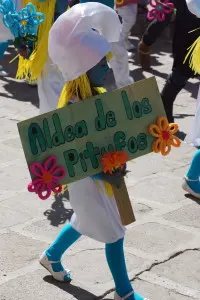
Smurf in Children's parade San Miguel de Allende

Smurf in Children’s parade San Miguel de Allende

and ecological, and anthropological, and about as cute as anything I’ve ever seen.

Is it racist to say that Mexican children are among the cutest in the world? I’ll risk it. These children threw themselves into their roles. For the duration of the parade (two hours mas or minus) they were authentic Kings, and Queens, and butterflies, and jaguars, and cows, and Smurfs. I wondered how the Aztec gods were going to react to the Smurfs, but they didn’t seem to mind.

With all those three to eight year olds there must have been a tantrum or two, but I didn’t see a single one. The children all seemed happy with their roles, nobody was left out, and they picked up their trash when they were through.

The Mexicans in San Miguel are comfortable with their mix of modern and ancient—
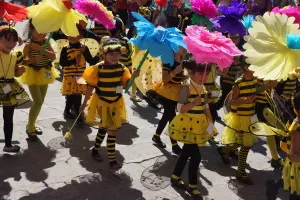
Children's parade San Miguel de Allende

Children’s parade San Miguel de Allende

comfortable enough to let a curious Norte Americano author look at them under a literary magnifying glass. I’ve based a few characters on my Mexican encounters (Owl Dreams, Southwest Gothic Tales, and Messages). More are on the way. Magic Popsicle Sticks and Trial Separation are two more Native American oriented novels chock full of the kind of magic realism that makes San Miguel so special.  Those books are under contract with Pen-L Publishing. They’ll be available after they work their way through the editing process.


Skeletons, Skulls and Mexican Festivals

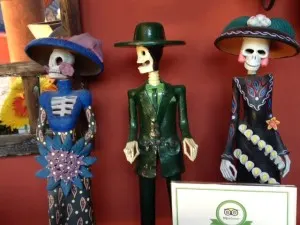
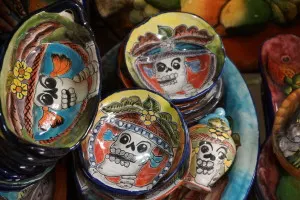
Catrina Images on china. Market in San Miguel de Allende

Catrina Images on china.
Market in San Miguel de Allende


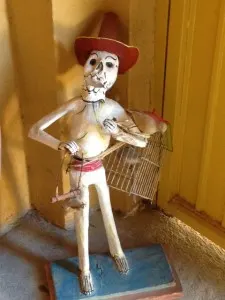
Skeleton in Mexican Folk Art. San Miguel de Allende

Skeleton in Mexican Folk Art. San Miguel de Allende

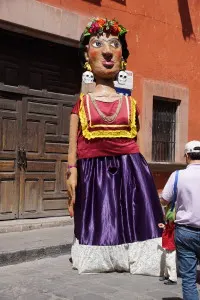
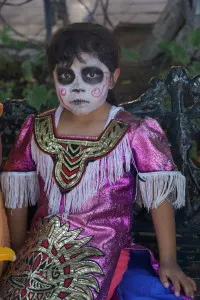
People in San Miguel de Allende love skeletons. Effigies wear skull earrings. Indigenous dancers have skull headbands and knee guards. Children’s faces are painted to make them look like stand-ins for Walking Dead. Every parade features a dancing skeleton or two.

The Mexican infatuation with human bones isn’t limited to parades. Skeletons star in Mexican cartoons. You’ll find plates and platters in any public market featuring skulls and skeletons. There are folk art sculptures of skeletons riding bicycles, cooking, repairing shoes and doing just about any mundane thing you can think of.  An Iconic figure of a well-dressed female skeleton named Catrina is seen all over Mexico. She was originally a sort of high-art political cartoon satirizing the life of the upper classes during the reign of Porfirio Diaz.

Everyone has heard of the Day of the Dead. It was co-opted into a Catholic-like holiday by the Spanish when they conquered the indigenous people 500 years ago. They managed to convince the local tribes to move the celebration from the ninth month of the Aztec Solar Calendar (approximately the month of August) to November first and second to

Skeletons in Folk Art. San Miguel de Allende

Skeletons in Folk Art. San Miguel de Allende

correspond with All Saints Day and All Souls Day. They also whittled the festival down from one month to only two days.

The Day of the Dead is a lot more like Halloween than Easter, and in case anyone’s forgotten, Halloween is not a Christian holiday. On day one of the celebration, people don wooden skull masks (Calacas) and dance in honor of relatives who have passed away. The wooden skulls are also placed on altars dedicated to deceased family members. If you have a

Effige with Skull Earrings. San Miguel de Allende

Effige with Skull Earrings. San Miguel de Allende

sweet tooth, you can eat a sugar skull with the name of a dead friend or relative printed on the forehead.

On the second day they take the party to cemetery where the festivities continues into the night. Then the living go home and the dead go back to being dead until the whole thing starts again next year.

Back when the Aztecs were running things in Mexico, the festival was presided over by Mictecacihuatl, “Lady of the Dead.” Skeletons were part of practically every celebration (as they are today in Mexico). Skulls were considered to be good luck and the gods were often portrayed as skeleton men. Quetzalcoatl (a star of the Aztec holy pantheon who saved the world by feeding his heart to the sun) was said to have stolen

Child in Festival Make Up. San Miguel de Allende

Child in Festival Make Up. San Miguel de Allende

bones from the god of the underworld and used them to create the different races of mankind. Things might have worked out better if he’d stopped before he made the Europeans.

Indigenous legends are so much more interesting than the spooky stories that thrilled and frightened us when we were young. That’s why everything I write has a little bit of indigenous magic woven into it.  Owl Dreams has a modern day Choctaw witch who changes identities instead of changing into animals. Southwest Gothic Tales includes a story about a modern day version of a Navajo skinwalker, and two more novels under contract with Pen-L Publishing, that deal with psychotropic drugs, secret societies and curses that might be magic or practical applications of psychology.

So far I haven’t worked skeletons into the mix, but who knows. If I spend enough time in Mexico I might give it a try.

A Little Spanish Wouldn’t Hurt

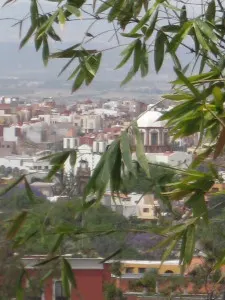
San Miguel de Allende

San Miguel de Allende

What do San Miguel locals think about all the Norte Ameriacano’s who have moved to their town over the last two decades? The gardener in one of the B & B’s we stayed in told me, “They should learn Spanish.” He said it in lightly accented English he learned while working in the United States. “Some of these people have lived here for ten years and they still don’t speak our language.”

That sounded like something I might have said—or at least thought—about the Mexican immigrants in Oklahoma City.

“A little Spanish wouldn’t hurt you either,” the gardener told me.

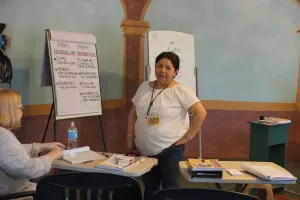
I took it to heart. My wife and I enrolled in The Warren Hardy School, which teaches

Level 2 Spanish Teacher at the Warren Hardy School

Level 2 Spanish Teacher at the Warren Hardy School

Spanish to English speakers in courses that typically meet three times a week, three hours a day, for three weeks. The classes are pretty effective, but as you might imagine, they leave some gaps in your conversational abilities.

Mexicans love it when you make an effort. They are very patient with Anglos who try to adapt to their culture. That doesn’t mean they’ll speak more slowly so you’ll have a better chance at understanding. When a Mexican speaks Spanish, the language

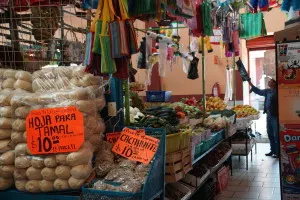
A little Spanish is useful if you want to shop in the local markets.

A little Spanish is useful if you want to shop in the local markets.

comes out like a heavy object dropped from a great height. The words keep picking up speed until they crash.

“Mas despacio por favor,”More slowly please—might work for a word or two, but by the end of the first sentence they’ve reached the speed of incomprehensibility again. Still, you pick up a word or two, and, what’s more important, they pick up a word or two, and even if what you said was wrong, they hardly ever laugh at you—at least while you are standing there.

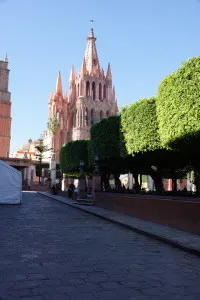
Parroquia de San Miguel. The trees are shaped like cylinders.

Parroquia de San Miguel.
The trees are shaped like cylinders.

A friend and I were looking for a good place to photograph the Parroquia (church). We ran into a man coming down w very steep hill as we were going up. Our conbersation started out great. He told us (I think) there was no good view where we were going, but he would show us a  killer “Buena vista.”

Before long it was clear he was taking us back where we had started, chattering in Spanish all the way, with lots of gestures and the only English he seemed to know: “Basketball! What the hell!”

“We’ve got to get rid of this guy,” I told my friend. Hopefully, with my Warren Hardy Spanish, we could do this without hurting his feelings. With my best Warren Hardy Spanish I tried to tell him we needed to go back home. I handed him twenty pesos—something all Norte Americanos do reflexively—and said, “Necesisitamous ir a su cassa.”

He backed away a little more quickly than I’d anticipated, but it was working.

“What did you say to him?” my friend asked.

Perro de San Miguel

Perro de San Miguel

It took me a minute before I realized I’d told him, “We need to go to your house.” I wonder what he thought the twenty pesos were for.

For my writer (and reader) friends, there’s a bonus to taking Spanish lessons. You can plant Spanish Easter Eggs (as my sister in law Emily calls them) in your stories. Elmore Leonard did it in Bandits. He buried the phrase, “No es pesado. Es mi hermano,” in a letter from Ronald Reagan soliciting contributions to stop communism in Nicaragua. The phrase was never mentioned again or explained but it means: “He’s not heavy. He’s my brother.”—a joke that only the in crowd will get.

I’ve hidden a few Easter eggs Owl Dreams, Southwest Gothic Tales, and Messages. Not Spanish Easter eggs, but I plan to start doing that right after I finish Warren Hardy level 2.

San Miguel de Allende

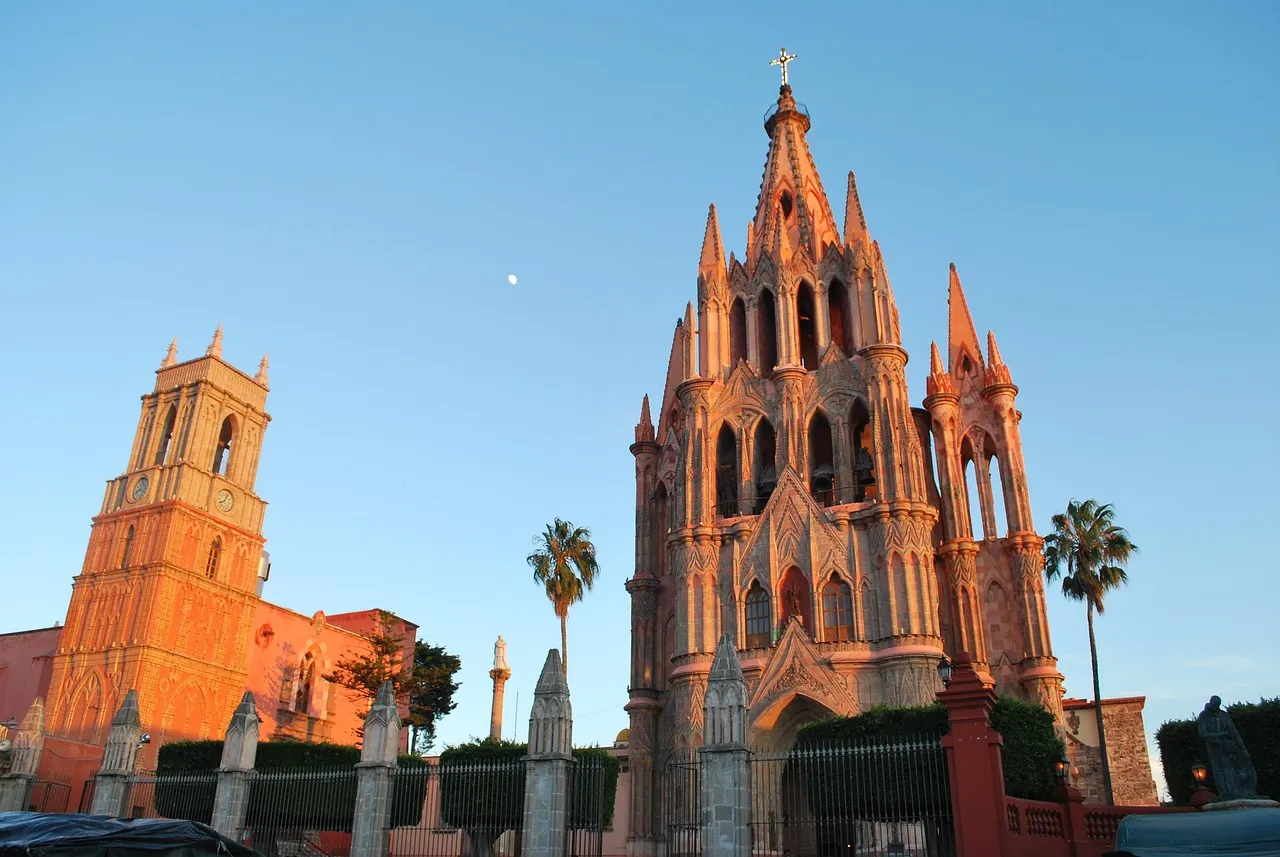
San Miguel de Allende The parroquia at night.

San Miguel de Allende
The parroquia at night.

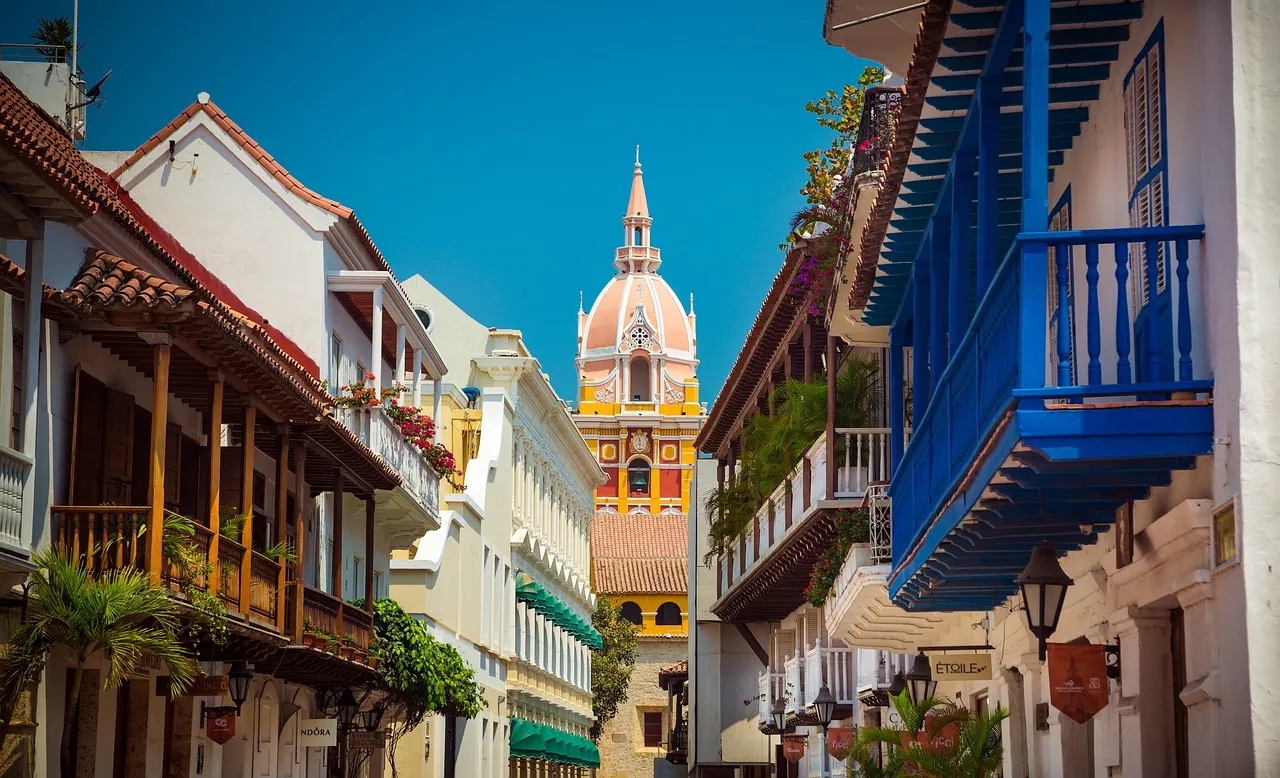
I wish I could tell you I like San Miguel de Allende for it’s historical significance as the birthplace of the Mexican war of Independence, but the truth is I am much more shallow than that. I like the city because it is drop dead gorgeous (I know that’s a cliché but it absolutely fits). For an opportunistic tourist like me the place is perfect. There is something to see at every turn.

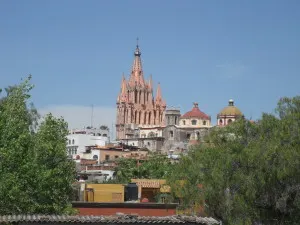
The Parroquia de San Miguel is one of the most photographed churches in Mexico. It has a neogothic façade with two tall towers that can be seen from everywhere in town. It looks good day or night and is located in a public square known as the Jardin (pronounced Hardin).

There are old buildings (three to five centuries

San Miguel de Allende

San Miguel de Allende

old) everywhere with brightly colored walls in various states of disrepair that only makes them look more beautiful. The climate is mild and dry, and something is usually in season. When it’s not, people hang flowers from balconies and in windows.

San Miguel almost always has a festival going on. There are parades, dancing in the streets—especially indigenous dancers—and plenty of refreshments suitable for every taste.

Vendors line the streets selling things I am familiar with (like ice cream and tortillas) and things I’ve never seen before but plan to try at my earliest convenience.

The Parroquia in San Miguel de Allende

The Parroquia in San Miguel de Allende

Children run loose in the pedestrian areas. Their parents are always close by, but in San Miguel it probably wouldn’t matter if they were or not, because everyone looks after the children. It is an incredibly family friendly place.

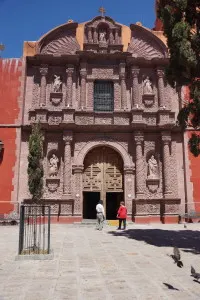
There are churches everywhere. The Nuestra Señora de la Salud Church was built of native sand stone in the 18th century in the shape of a large seashell. People gather in front of it for festivals and just to sit underneath trees with branches trimmed in the shape of cylinders.Right next to the Nuestra Señora is Oratorio de San Felipe Neri Church, built in the Baroque style of pink sandstone covered by rich vegetative ornamentation. This used to be the place of

Pink Sandstone church in San Miguel de Allende

Pink Sandstone church in San Miguel de Allende

worship for the mulatto population. Now it’s open to everyone. There is no official racial discrimination in the city.

San Miguel is an animal friendly town. People still use burros to make deliveries. Dogs are welcome on the streets and in many of the stores. There are no leash laws as far as I can see. The animals seem at least as well behaved as the people, and the people and in this city that is saying something.

People are formally polite. They greet you in the street and ask permission (con permiso) to walk in front of you. They always say please and thank you, just like our mothers always told us we should.

So far I haven’t incorporated San Miguel into any of my fiction, but it’s a sure bet I’ll use bits and pieces of it in the future. It’s the perfect backdrop for a magic realism writer. Come see for yourselves.

Isn’t Mexico Fun?

The door opened and they started filing out.

The door opened and they started filing out.

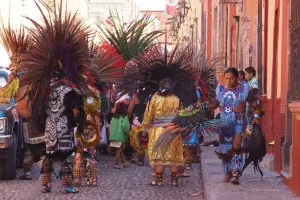
My wife and I and a friend were walking along one of the cobble stone streets of San Miguel de Allende when a door opened and a man walked out wearing a peacock feathered headdress. He also wore a skull mask and had plastic replicas of human skulls on his knees and elbows. He wasn’t wearing a shirt but it was hard to tell because his skin was painted black and white.

Then the door opened again and a troop of similarly dressed men and women

Banners for March 7 Festival

Banners for March 7 Festival

streamed out like a scene in a surrealistic keystone cops movie. My wife turned to me and said, “Isn’t Mexico fun?”

I thought for a moment I had fallen into one of my own Magic Realism stories (You knew I’d throw that in there somewhere, didn’t you: Owl Dreams, Southwest Gothic Tales, Messages). Fortunately there was a real world explanation. This was the Festival in honor of God the Conqueror. A Christian holiday that I’d never

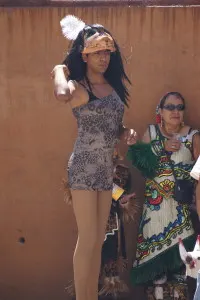
Somehow transvestites got worked into the mix.

Somehow transvestites got worked into the mix.

heard of, following on the heels of Ash Wednesday.

Representatives from churches all over central Mexico came in to participate. The festival was mostly indigenous dancers who I wouldn’t have known had anything to do with Christianity if it hadn’t been for the banners some of them carried. Somehow transvestites got into the mix along with people dressed as devils, skeletons, and hacienda patrons wielding whips. Mock machete fights started around dusk followed by more dancing. All the while little children were pelting each other with paper eggs filled with confetti.

The next morning I asked the maid in our B&B about the festival. Her English was about as good as my Spanish—not very good at all—but basically what she said was, “Don’t they have Catholics where you come from?”

Isn’t Mexico fun?

A Very Cute Boy

A very Cute Boy

A very Cute Boy

No one thought 18 year old Norodom Sihanouk would be appointed King of Cambodia when his grandfather King Sisowath Monivong died in 1941. Not Sihanouk’s father, who was alive and well and ready to assume the crown; not the Royal Council of the Throne, who had plenty of older, wiser, members of the royal family to elect; certainly not Sihanouk himself. He was a good looking young man who liked fast cars, pretty girls, race horses, and dancing, but had no interest in politics.

The Vichy French were in charge of Cambodia and from their perspective an empty-headed teenage boy was exactly what the country needed. When the Governor General of Indochina was asked why Sihanouk was chosen, his wife chimed in: “Because he was a very cute boy.”

Sihanouk in the French Colonial Days

Sihanouk in the French Colonial Days

Gotta love the French. With a king like Norodom Sihanouk they believed they’d have Cambodia in their pockets for decades to come. They were the Vichy French, remember. They made a lot of bad decisions. They joined the losing side of WWII, tried to solidify their hold on Algeria with brute force, and set themselves on a collision course with Vietnam.

It’s a small wonder Sihanouk wasn’t enthusiastic about his promotion to the top political job in the country. As a member of the royal family, he already had most of the perks of the crown without the considerable risks. “My first reaction was of fear,” he wrote. “Of fright, I broke into tears.”

There was a lot to be afraid of. The Vichy were in charge of Indochina, but the U.S. had just entered the second world war (on the other side) and was certain to send ships into

Rise of Khmer Rouge

Rise of Khmer Rouge

the South China Sea. A rebellion was brewing in Southeast Asia. It was concentrated in Vietnam but there was anti-French sentiment all over the Indochinese peninsula. Things were almost certain to go wrong, and when they did, kings usually got the blame.

Sihanouk turned out to be a quick study at going with the political flow, which made him a big disappointment to the French. He was good at figuring out what was coming next, great at avoiding blame, and could change his political alliances in the blink of an eye—apparently without making enemies.

With the help of the Japanese (supposedly France’s ally), he declared independence in 1945. Then in 1946 he realigned with the French (who were back in power once the Vichy were gone) and convinced them to grant his country independence (Nov. 9, 1953). Two years later, when France lost her grip on Southeast Asia, Sihanouk made friends with Vietnam.

In 1955, the king decided to go into politics for real. He passed the crown to his father—sort of a backwards hereditary monarchy, The Popular Socialist Community, and was elected president. By that time, the cold war had reached the freezing point, and Sihanouk walked a very dangerous Southeast Asian tightrope stretched between Russia, China, and the U.S.A. He compared his political strategy to that of an ant in the middle of the elephants’ fight.  During this period, he alternated between being president and prime minister. It really didn’t matter. Power followed Sihanouk into whatever office he occupied and all the while he maintained the title of sovereign prince.


Victims of Khmer Rouge

Victims of Khmer Rouge

When his government was overthrown by a U.S. backed military coup in 1970, he aligned himself with the Khmer Rouge and was restored to power—at least for a little while. By 1975 when Pol Pot (head of the Khmer Rouge) reduced him to a puppet head of state and started murdering Cambodians by the millions.

Sihanouk sat most of the Cambodian blood bath out in China and North Korea, but was made king again when the Khmer Rouge were defeated by the Vietnamese. He remained in power until 2004 when he voluntarily retired and was named King Father of Cambodia.


Cambodia Mourns Sihanouk

Cambodia Mourns Sihanouk

By the time Sihanouk died at age 89, he had held so many positions that the Guinness Book of World Records identified him as the politician who has served the world’s greatest variety of political offices. These included two terms as king, two as sovereign prince, one as president, two as prime minister, and numerous positions as leader of governments-in-exile.

If I were to include a political career as outlandish as Norodom Sianhouk’s in a piece of fiction, and went so far as to give it a happy ending . . .  there’s probably no way I could make it sound believable. Is there? You really ought to check it out for your self in Owl Dreams, Southwest Gothic Tales, Messages, and many other works of fiction listed in this blog.