The Fashionable Cemeteries of Paris

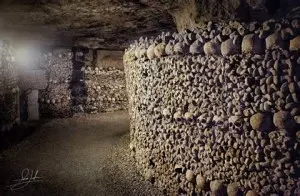
Crypt in the quarries below Paris.

Crypt in the quarries below Paris.

No matter how many negative things Americans say about the French (and lets face it, the list is pretty long) we have to admit they have a lot of style. Their language sounds like poetry. They have been the vanguard of every art movement dating back to the Renaissance. They know more about wine than anyone else and lead the world in fashion and cooking. Everything in France is pretty or tastes good or both. It should come as no great surprise that the French display elegance even in death.
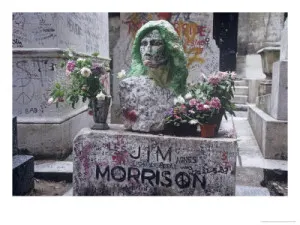
Jim Morrison's grave at Pere Lachaise Cemetery

Jim Morrison’s grave at Pere Lachaise Cemetery

At the end of the 18th century the principal cemetery in Paris (Holy Innocents Cemetery) was closed. It was over crowded and poorly managed and was generally considered to be an esthetic and public health menace. The bones and partially decomposed bodies were cleaned and removed to underground quarries under the city, where they are stored to this day. French entrepreneurs collected the fat from partially decomposed bodies and rendered it into soap and candles. Hopefully all of those products were used up long ago.
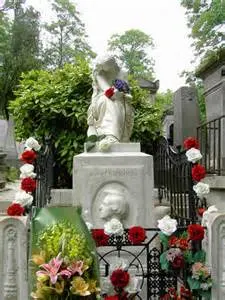
Chopin's grave at Pere Lechaise cemetery

Chopin’s grave at Pere Lachaise cemetery

Four new cemeteries replaced the Cimetière des Saints-Innocents: Pere-Lachaise, Montmartre, Montpasse, and Passy.

Pere Lachaise is by far the most famous. This graveyard was named for the confessor to Louis XIV, Père François de la Chaise (1624–1709), who lived in the Jesuit house on this site. It took a while for this cemetery to catch on with the fashionable Parisian dead. The first year it was open, Pere-Lachaise had only thirteen occupants.

To stir the interest of the public, the remains of famous Parisians were removed to the cemetery, including two well-known Parisian lovers (another thing the French are famous for). Pierre Abélard and Héloïse d’Argenteuil were interned in a specially built
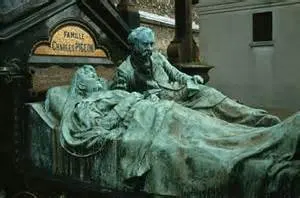
Man and wife retiring for eternity at Montparnasse Cemetery.

Man and wife retiring for eternity at Montparnasse Cemetery.

mausoleum. By tradition, lovers and lovelorn singles leave letters at the crypt in tribute to the couple or in hope of finding true love.

The promotion worked. Today, the cemetery and the ossuary (where bones and cremains are stored after the leases on gravesites have expired) contain what’s left of 3,000,000 bodies. In order to be buried at Pere-Lachaise you have to have an association with France. Dying there is good enough. Jim Morrison is buried this cemetery. His grave has been the subject of a great deal of vandalism. Chopin is also buried at Pere-Lachaise
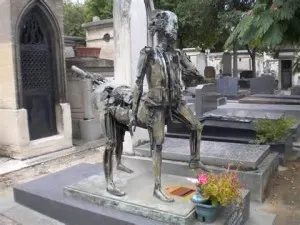
Surrealistic monument at Montparnasse Cemetery

Surrealistic monument at Montparnasse Cemetery

—no graffiti on his grave, but people still leave flowers.

Many of France’s intellectual and artistic elite are buried in Montparnasse Cemetery. There are traditional monuments to Parisian police and firefighters killed in the line of duty. There is also has a large collection of monuments that depict moments in the lives of the deceased. Some Montparnasse monuments are surrealistic and even abstract.
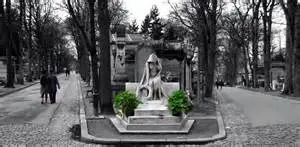
Elaborate Cemetery Sculpture at Montmartre

Elaborate Cemetery Sculpture at Montmartre

Montmartre Cemetery (originally known as Cemetery of the Quarries) is on the site of an old gypsum quarry, which was used as a mass grave during the French Revolution. Many of the monuments in this cemetery are exquisite (if somewhat depressing) sculptures that look as if they belong in a museum rather than a graveyard.

Passy Cemetery is located in the shadow of the Eifel Tower. It is situated in the
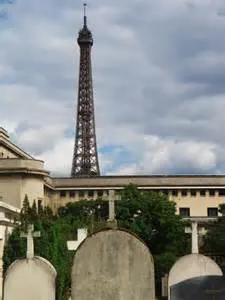
Passy Cemetery, the most exclusive graveyard in Paris

Passy Cemetery, the most exclusive graveyard in Paris

expensive residential and commercial districts of the Right Bank near the Champs-Élysées. by 1874 the small Passy Cemetery had become the aristocratic necropolis of Paris. It is the only cemetery in Paris to have a heated waiting-room (for visitors, not for residents).

Anyone who reads my fiction (Owl Dreams, Magic Popsicle Sticks)—or my blog—knows I have a special place in my heart for cemeteries. I am especially fond of cemetery art, and some of the best funereal sculpture in the world is found in these four cemeteries. I recommend visiting the four famous graveyards of Paris if you are ever traveling in the region. It is easy to see why people are dying to get in.
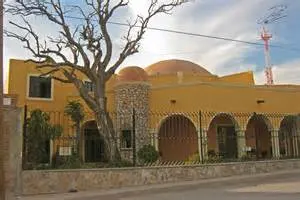
Museum of the Mummies–Guanajuato

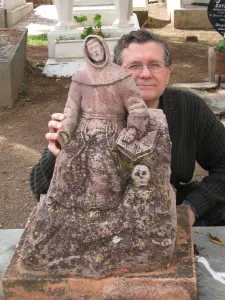
Me posed beside a monument in a Guanajuato  cemetery.

Me posed beside a monument in a Guanajuato cemetery.

I like graveyards. There’s a funeral or at least a burial scene in practically everything I’ve written. I’ve visited famous cemeteries all over the world, including: the St. Louis Cemetery in New Orleans, the Old Jewish Cemetery in Prague, Pere-Lachaise Cemetery in Paris, the Highgate Cemetery in London, and, of course, the Pyramids of Egypt. I like the mysticism, and the elaborate tombstones, and the rituals that are part religion and part performance art.

Many people share my fascination. Otherwise they wouldn’t spend so much time and energy—not to mention money—on funerals and crypts, and all the fantastic graveyard art, especially in the old world cemeteries. Burial is not so much a way of disposing of the dead as it is a last right of passage, out of this world into the next—the

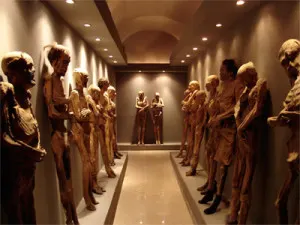
Museum of the Mummies in Guanajuato, Mexico

Museum of the Mummies in Guanajuato, Mexico

final act of the dearly departed after which everything will be different because they are no longer be around.

Every culture has burial and funeral customs. Some of them are solemn and some of them are just plain weird, but everybody has them—even New Age agnostics—and on a very basic level they are all the same. Whether we bury our loved ones under a twenty ton slab of granite or we scatter their ashes on the Appalachian

Standing room only in the Museum of the Mummies

Standing room only in the Museum of the Mummies

Trail, we do something that is meaningful to us, and (we hope) will be meaningful to the loved ones whether they actually know about it or not.

When I learned about the Museo de las Mommias in Guanajuato Mexico I thought: “This is right up my alley.” I thought Mexican mummies must be the product of some ancient Central American pre-Columbian culture. They had pyramids didn’t they? So maybe pyramid cultures came equipped with mummy technology.

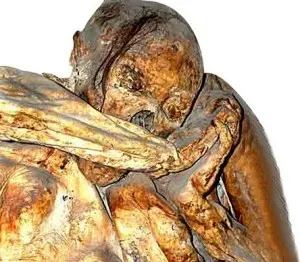
Ignacia Aguilar (who may have been buried alive)

Ignacia Aguilar (who may have been buried alive)

Imagine my surprise. The Guanajuato mummies weren’t the product of an elaborate embalming routine. They were people who were buried in crypts roughly between the years of 1830 and 1958. Most of them died in a cholera outbreak in 1833.

In 1865 the city imposed a local tax for burials. A family could pay a one time fee of 170 pesos and be done with it. If they didn’t have 170 pesos to spare they could elect to pay the city a 50 pesos per year. If they neglected to pay, for any reason, the deadbeat dead were removed from the crypts

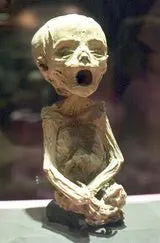
Fetal Mummy--advertised as the world's smallest

Fetus Mummy–advertised as the world’s smallest

and stored in a warehouse. Most of the bodies had disintegrated, but about 2% of them had mummified naturally.

The cemetery workers started charging Mexican tourists a small fee to come and view the natural mummies. Bits and pieces of the bodies were taken by tourists as souvenirs. Over the years, the warehouse became a popular destination and eventually the warehouse was turned into a museum.

 In 1958 the tax law was changed and no more bodies were disinterred but by then the museum was going strong. It gained popularity in 1970 with the release of a movie, Santo Versus the Mummies of Guanajuato, starring the popular masked wrestler Rodolfo Guzmán guanajuato.jaramilloHuerta.

The mummies were the inspiration for the short story, “The Next in Line” by Ray Bradbury. In the introduction to his collection, The Stories of Ray Bradbury, the author wrote: “The experience so wounded and terrified me, I could hardly wait to flee Mexico. I had nightmares about dying and having to remain in the halls of the dead with those propped and wired bodies. In order to purge my terror, instantly, I wrote ‘The Next in Line.’ One of the few times that an experience yielded results almost on the spot.”

The mummies have gone on tour in the United States and have been shown in The Detroit Science Center in 2009, The West End Dallas Market in 2011, and The Natural Science

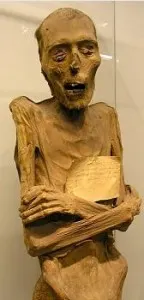
Mummy dressed in modern clothing

Mummy dressed in modern clothing

Center of Greensboro in 2012. The collection includes a fetal mummy (advertised as the world’s smallest) and the mummy of Ignacia Aguilar (who may have been buried alive). Most of the mummies are naked. A few are wearing socks (with shoes and without). Some are fully dressed in what appears to be fairly modern clothing.

Sometimes truth really is stranger than fiction. You can read my fiction and make the comparison yourself. Major scenes in Owl Dreams take place in a cemetery. There are cemetery / burial scenes in Magic Popsicle Sticks and Trial Separation (to be released soon by Pen-L Publishing), and the streets are literally littered with the dead in the Kindle short, “Messages”.


Vikings in Oklahoma? The Heavener Runestone


Before it was enclosed.

Before it was enclosed.

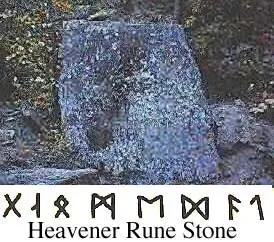
In 1832 a Choctaw Hunting party discovered a rock engraved with mystical symbols on Poteau Mountain. It wasn’t hard to find. This stone was twelve feet tall, ten feet wide and sixteen inches thick. It had eight angular figures chiseled into the surface about eye level. Those symbols had to mean something, and since the Choctaw didn’t know what that might be, they quickly left the area.

White hunting parties also ran across the stone from time to time. Most of them dismissed it as an Indian Rock, but in 1923 an Oklahoma school teacher named C.F. Kemmerer decided to investigate. He wrote a letter to the Smithsonian Institute in Philadelphia with a sketched representation of the symbols and asked if it was worth pursuing. He was told the symbols were a mix of Scandinavian and Gothic runes. No one came to look at the rock and the best translation they could offer was, gjomedat. No real translation at all.

Gloria Stewart Farley

Gloria Stewart Farley

In 1928, Kemmerer took 12 year old Gloria Stewart (daughter of a Heavener physician and a librarian) to see the stone. It made such a strong impression that she recalled the inscription 20 years later when she read about the discovery of the Kensington Runestone in Minnesota, believed to pre date Columbus by a century. She was living in Ohio by that time, married to Reverend J. Ray Farley, but she was inspired to send a copy of the symbols—as C.F. Kemmerer did—to the Smithsonian Institute. The Curator of the department of archeology replied. He told her of Kemmerer’s earlier communication and suggested that whoever chiseled the runes followed Scandinavian grammar.

When Gloria Stewart Farley moved back to Heavener, Oklahoma in 1950, she set

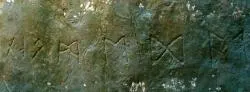
Heavener Runes

Heavener Runes

about doing her own research on the “Heavener Runestone”. She exchanged information with a number of interested parties, including: science fiction author, Frederick Pohl, cryptographer Alf Monge, and architect, Richard Nielson.

Frederick Pohl consulted a number of academic rune experts, none of whom believed the runes were an authentic pre-Nielson-Farley_Glome_Dale_2.29690536_stdColumbian message. A number of complicating factors were cited: (1) The grammar was confusing. (2) The second and the eighth rune are Scandinavian but the other runes are from a Gothic alphabet. (3) There is a small slash stroke next to the runic M that may be a ninth rune. (4) Rune writing was sometimes read right to left instead of left to right. (5) The eight rune is reversed.

All this confusion has led to a number of interpretations. Read right to left, it could be

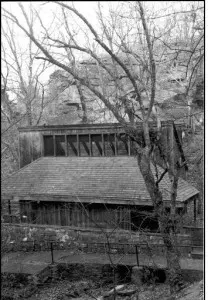
The Runestone is enclosed in a protective house today.

The Runestone is enclosed in a protective house today.

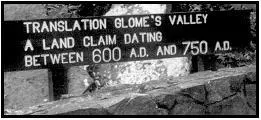
translated “The Seven Demons”. Read left to right, it could be a simple date (1,000 A.D.), or a land claim (Glomedal—Glome’s valley), or another message that defies comprehension (gjomedat, gjnomedal).

In her book, In Plain Sight, Gloria Farley took the position that the stone was a Viking Land Claim dating around 650 A.D. She was instrumental in having a state park (now under local control) built around the stone in 1970 based on this “Official Position”. In 2011, the park lost its status as a state facility due to budget cuts and is now operated by the city of Heavener.

Recently, academic Lee Woodward (Doctor of Ministry) has developed a new theory. He believes the Heavener Runestone is a secret monument to the French Explorer LaSalle who may have been killed by the Spanish near

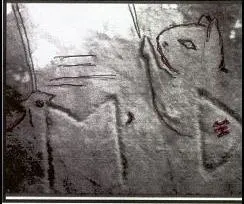
Dr. Lee Woodward's enhanced picture

Dr. Lee Woodward’s enhanced picture

present day Heavener, Oklahoma, during his 1686-1687 expedition.  A member of that expedition James Hiens was known for leaving arcane messages in runes that would not alert military adversaries. Woodward enhanced pictures of the runes to bring out features no one else has noticed, including: James Hiens initials, directional markers, and barely visible maps to where La Salle was murdered. He also found a drawing of a cat and has a linguistic explanation of how that image fits with his theory.

It’s safe to say that no one can speak with any unassailable authority about the origins of the Heavener Runestone. It’s a mystery, one of the things that make the state of Oklahoma a very interesting place to live—Perfect for a fiction writer.

Check out my Oklahoma fiction, loaded with Native American mysticism and written from a distinctive Oklahoma point of view: Owl Dreams, Messages, Southwest Gothic Tales (Free Download), and Magic Popsicle Sticks (Coming Soon). You can also find my stories in anthologies available on Amazon, here.