“Unfinished Business” in PURE FANTASY AND SCI-FI vol. 3

“Unfinished Business” was published in Pure Fantasy and Sci-Fi on March 27, 2015

“Unfinished Business” opening paragraphs

Sinti’s mother always knew when someone was on the way to the cabin. “Spirit telegraph,” she said, but Sinti thought it was the buzzards. The footpath to the Maytubby cabin started under the roosting tree and those big ugly birds weren’t the least bit sociable. When a car pulled to the side of Nanih Waiya Road the carrion birds flushed into the sky like quail. They flew above the roosting tree in interlocking circles that looked like figure eights and Idabel Maytubby would tell her daughter, “Someone’s coming.” She was almost always right.

It was a ten-minute walk from the road to the cabin if visitors followed the footpaths. The trail was clear enough for people who knew what they were looking for. The locals did. They were Choctaw; it was in their blood.

The route to the healing woman’s cabin had been common knowledge among the tribe since Idabel Maytubby moved there twenty years ago with her newborn fatherless daughter, Sinti. Visitors had been coming longer than Sinti could remember. One or two at a time. Mostly women.

You can buy Pure Fantasy and Sci-Fi vol. 3 here.


“Sassafras” reprinted in PURE FANTASY AND SCI-FI vol. 3

“Sassafras” was first published in the trade paperback and ebook, Shadow Masters, Imajin Books, May, 2013. It was subsequently published I Pure Fantasy and Sci-Fi vol. 3 on March 27, 2015.

“Sassafras” opening paragraphs:

Smell is the simplest sense. Awareness enters through the nose without an invitation, an unwelcome guest with a master key. An injured brain needs only a few molecules to remember everything there is to know about disinfectant, urine and adhesive tape.

Sound comes next: distant conversations, wheels with bad bearings, compressed air hissing at regular intervals. Fifteen times a minute, but who’s counting.

Then vision. Two of everything—separate images that won’t come together without a struggle. The first thing is acoustic tile on a ceiling a thousand miles away. Then a pair of faces merging into one. A man I recognize but don’t remember. A lover? A brother? Something else entirely?

You can find Shadow Masters on Imajin Books website, here.

or on Amazon, here.    

 You can buy Pure Fantasy and Sci-Fi vol. 3 here.


Butterflies and Bandits

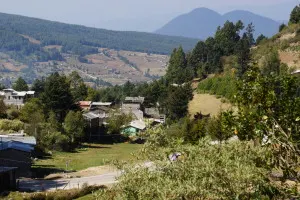
Michoacan, Mexico. The countryside.

Michoacan, Mexico. The countryside.

Things have gotten pretty bad in Michoacan (one of the 31 states of Mexico) in recent years. The murder rate has skyrocketed. Politicians are being assassinated in record numbers. Crimes against women are among the highest in the world. The Universities are under siege with students battling against municipalities and against non-students who are clamoring to get in.

A vigilante group who call themselves THE KNIGHTS TEMPLAR, organized to fight the ZETA criminal cartel. After a decades long bloody battle, the KNIGHTS TEMPLAR have

Police cars stationed around a park in Morelia, Michoacan.

Police cars stationed around a park in Morelia, Michoacan.

taken over most of the ZETAs criminal activities and have opened trade with organized crime syndicates all over the world. Now a new vigilante movement has taken hold and there is open warfare between them and the KNIGHTS TEMPLAR and remnants of the ZETAS. Soldiers in the new vigilante movement include members of Latino gangs from the U.S., who have either been deported or who have voluntarily left United States jurisdiction to avoid prosecution.

The Mexican government has sent in federal troupes because the municipalities are corrupt and the police can’t be trusted. The U.S. State Department has issued travel warnings advising citizens to avoid all but essential travel in Michoacan. U.S. government employees are prohibited from traveling by land in The Mexican state except on federal toll road 15D during daylight hours.

Monarch Sanctuary

Monarch Sanctuary

So my wife Margaret said to me, “Lets visit the Monarch butterfly sanctuary in Michoacan while we’re in Mexico,” and I said, “Sure, why not.” Ignorance is bliss.

Who wouldn’t want to see the Monarchs? There are undeniable mystical overtones to the Monarch migration, perfect for a writer who dabbles in Magic Realism. Up to a billion of these delicate creatures leave their home in eastern Canada and fly 2,500 miles to the mountains of central Mexico. They arrive when locals are celebrating the Day of the Dead (October 31 to November 2).
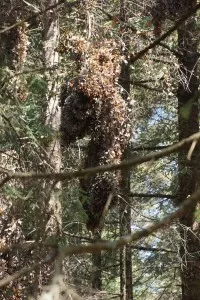
Monarchs clustered in pines

Monarchs clustered in pines

For those of you who aren’t familiar with the holiday, it is a remnant of an Aztec festival that was celebrated at the beginning of summer. The Catholic Church tried to eradicate it but was only able to shorten it and move it to a time that coincided with a vaguely similar All Saints Day festival. On the day of the dead, the spirits of the ancestors visit the living. The living throw a party for the occasion with feasts and costumes (mostly skeletons) and parades. The locals in the mountains of Michoacan say the butterflies are the ancestral spirits. The timing is right, and it does seem like quite a coincidence.

There’s more. The typical Monarch life cycle lasts 4 to 5 weeks, starting as an egg, going through the larva period, morphing into a pupa until it reaches the adult stage when it reproduces and then dies. But when summer is over in Canada and temperatures drop drastically, a special generation is born. This new group will fly all the way to Michoacan where they can hibernate, feed, mate, and then travel back home. This different kind of Monarch is known as the Methuselah generation. These migratory Monarchs live as long as eight months. This age old miracle is observable, measurable, and totally without explanation—practically the definition of Magic Realism.
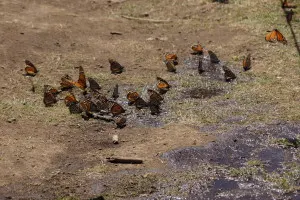
Monarchs drinking from pools of water.

Monarchs drinking from pools of water.

We hired a driver—I’m so glad we did—who took us to the Butterfly reserve. We climbed the mountain and witnessed millions of Monarchs clustered in the pine trees so thick they bent the branches. When they swarmed, we could hear the sound of thousands of wings moving the air. It was a spectacle I will never forget.

Follow this link to see and hear Monarchs taking flight IMG_0344

I never thought once about the dangers—or knew about them truth be told—until we were on the highway to Morelia, the second part of our trip. The toll booth (yes, they have those in Mexico too) just before we got into the capitol city of Michoacan had been taken over by about 20 young men our driver called “the boys”.

Monarchs seem to prefer white flowers.

Monarchs seem to prefer white flowers.

They were students, he told us, or they would be students if times were better. Until things moderate, they hijack toll booths and demand money before they let cars pass. The going rate was 100 Pesos (about 7 U.S. dollars). There were several Michoacan police cars on the other side of the booth. They didn’t intervene.

“Sometimes the boys get aggressive,” our driver said. “Sometimes they block traffic for hours. This time we were lucky.”

For better or for worse, that’s what it’s like in Michoacan these days. Luck is an inexpensive inconvenience that could have been worse. There are butterflies and there are bandits. Unforgettable, but I don’t think I’ll make that trip again.


 

The Red Stick War & Magic Realism

Why am do I write about Native Americans?

Why am do I write about Native Americans?

“Why do you write so much about Native Americans?” is a question I get all the time. In practically every story the hero and / or the villain as well as multiple supporting characters will be tribal members.

“I think Indians are about the most interesting people in the whole world,” doesn’t sound nearly intellectual enough—even though it is exactly right—so I usually say something like this: “The unbroken thread of mysticism that runs through Native American culture fits perfectly with my concept of magic realism.” If that doesn’t clear things up, I try a little harder.

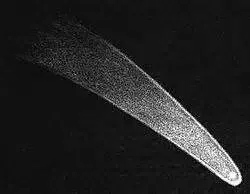
Drawing of the Great Comet of 1811

Drawing of the Great Comet of 1811

Great events we don’t remember have mainstream Euro-Americans throwing salt over our shoulders, avoiding black cats, stepping over cracks, and leaving the thirteenth floor out of our buildings for reasons we don’t understand but must believe on some level. The same thing applies to Native Americans. They have a history that reaches back fifteen thousand years. Most of it isn’t written down but it’s been carried into the present by legends and ceremonies and lessons learned around the evening meal. It’s part of who they are.

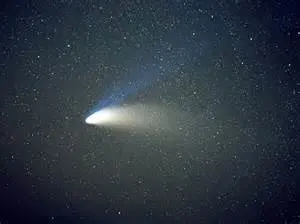
Hale Bop Comet

Hale Bop Comet

Native American history is unique, so the way they approach the world is unique too. Whether they are lawyers, doctors, ministers, teachers, artists, writers, politicians, unskilled workers, soldiers, or criminals they put an American Indian spin on everything they do. That spin is what makes them the most interesting people in the world.

To get an idea how different background leads to different world-view, consider the Red Stick War.

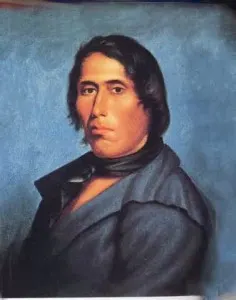
Tecumseh

Tecumseh

In March of 1811 the brightest comet in recorded history made an appearance in the night skies over the United States. The Great Comet of 1811 didn’t lose the title of the biggest and the brightest until the appearance of the Hale Bop Comet in 1997. Remember what happened in southern California then? If you don’t, Google Heaven’s Gate.

When a Shawnee mystic named Tecumseh saw the comet he took it as a sign. He traveled around the country telling everyone who would listen that the fuzzy light in the sky was a supernatural message. The very nature of the Indians’ relationship with their tribal lands was about to change.

He encouraged tribes to unite against further white incursion on their lands before it was too late. He found a willing audience when he visited the Muskogee Creek, whose tribal territory (most of what is now Alabama and part of Georgia) was starting to look very good to white farmers.

Tecumseh promised a sign would follow his visit, which would prove his prophecy was true. When the New Madrid earthquake struck in December, a large number of Creek were convinced.

The Muskogee who joined the Tecumseh Confederation were known as the Red Sticks. The name may have come from red war clubs they carried, or from bundles of red sticks they used to count the days between strategic events. Half the Creek Nation joined in the movement and the other half were firmly against doing anything that would provoke the U.S. government. The division started a civil war inside Muskogee territory.

Ordinarily, the Red Stick war would have played itself out on tribal land but the War of 1812 had just started. The British armed the Creek Red Sticks and their Seminole allies and encouraged them to attack U.S. Army positions. When that happened, General Andrew Jackson moved his troops into Creek lands and by August 9 of 1814 he forced the tribe to sign the Treaty of Fort Jackson.

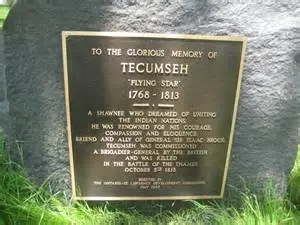
In memory of Tecumseh

In memory of Tecumseh

Despite protest of the Creek chiefs who fought the Red Sticks alongside Jackson, the Creek Nation ceded 23 million acres (93,000 km²)—half of Alabama and part of southern Georgia—to the United States government.

Eight years later, President Andrew Jackson forced the Creek to sign the Treaty of Cusseta, relinquishing their remaining lands east of the Mississippi and accepting “voluntary” removal to Indian Territory. The Army force-marched nearly 20,000 Creek across Tennessee and Arkansas starting in 1834. Three thousand five hundred Indians died in the process.

The Great Comet of 1811 really did portend a significant change in the Creek’s relationship with their land, even if it didn’t go exactly as Tecumseh planned.

That’s the unbroken thread of mysticism that fits perfectly with my concept of magic realism.