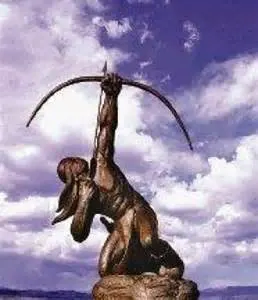
Allan Houser

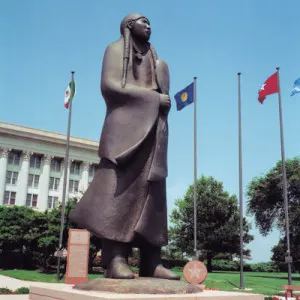
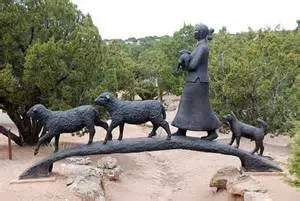
th-1Every Oklahoman is familiar with Allan Houser’s sculpture, even if they don’t know his name. A picture of Sacred Rain Arrow is on our license plate. As Long as the Waters Flow is in the south plaza our state capitol grounds. He has pieces in our airport, in several of our art museums and on the campus of Oklahoma University in Norman.

 The rest of world also knows Houser’s art. His work is included in the permanent collections of over 70 museums across the United States, Europe and the Far East. His career spanned six decades, and his influence can be seen in contemporary, modern sculpture and graphic art. Among his other honors, Allan Houser was the first Native American to receive the National Medal of Arts.
Pretty impressive for the child of two people who spent their early lives in prison.

Houser’s father, Sam, was Geronimo’s first cousin. He was a very young man when the Apache wars ended. In 1886, members of his tribe—Chiricahua Warm Springs Apaches—were loaded into cattle cars and shipped from the deserts of New Mexico and Arizona to the swampy lands of the American southeast. Sam was among the women and children jailed at the Castillo de San Marcos th-2in St. Augustine, Florida. Allan’s mother, Blossom, was born in the prison camp at the Mount Vernon Barracks in Alabama where surviving members of the tribe were sent in 1887.
 About 300 captive Chiricahuas were eventually sent to Fort Sill, Oklahoma where they were held for another 23 years. Allan was the first member of his family born out of captivity shortly after the Apaches were released in 1914.
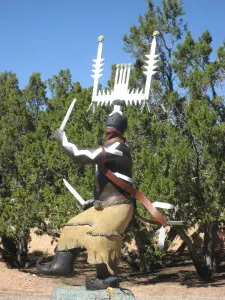
Mountain Spirit Dancer

Mountain Spirit Dancer

His birth name wasn’t Houser. Back then it was Haozous (loosely translated: the sound of going away). If Allan Houser were a protagonist in a magic realism novel we’d call that symbolism.

When the Apaches were released from Ft. Sill, most of them went to the Mescalero reservation in New Mexico. Eighty-one adults, including Sam and Blossom Haozous accepted land allotments around Apache and Lawton Oklahoma.

It seemed Allan Houser was destined to become an Oklahoma farmer during one of the worst droughts of the 20th century. But in 1934 he noticed a magazine ad for an art school in Santa Fe (The Dorothy Dunn School) and applied. Allan excelled at drawing and painting and became the school’s most famous student. By 1939 his work was exhibited
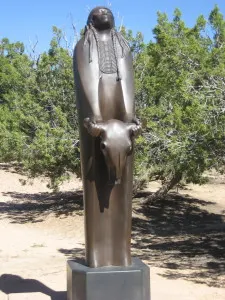
Allan Houser's sculpture garden

Allan Houser’s sculpture garden

in San Francisco, Washington D. C., and Chicago.

In 1947 Haskell Institute in Lawrence Kansas solicited applicants to do a commissioned marble sculpture honoring former students who died in WWII. Even though he had never done a full size sculpture before and had never worked in marble, Allan managed to persuade the jury to give him the commission.

 Comrade in Mourning was the result. It became the iconic Native American Sculpture of its day and launched Allan Houser’s career.

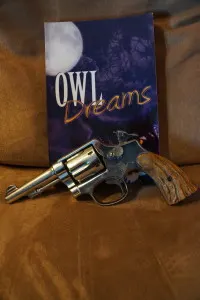
 Native America always plays an important role in my fiction (Owl Dreams,
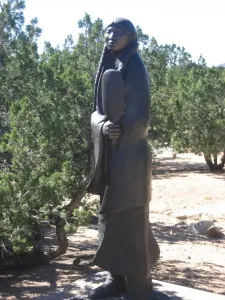
Sculpture Garden / Houser

Sculpture Garden / Houser

Messages, Southwest Gothic Tales). That makes me a natural fan of Allan Houser. His life would fit seamlessly between the covers of a magic realism novel—A member of a generationally imprisoned minority becomes a world famous artist. In Houser’s case the story is magic but it’s also true.

Allan Houser’s art can be found in collections all over the world, and starting May 1. 2014, some selected works will be exhibited on the roof of the Oklahoma City Museum of Art. Everyone who can should go and see it.
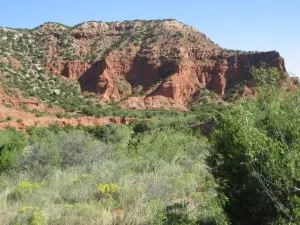
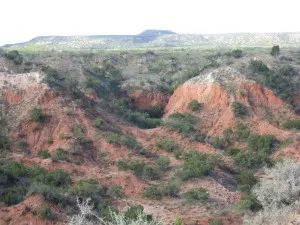
 

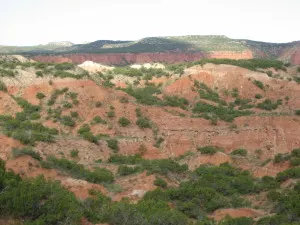
Caprock Canyon

Caprock Canyon

Caprock Canyon

If you drive through the Texas panhandle you’ll see miles of empty grasslands, feedlots that make you consider becoming a vegetarian, and small towns that look like they could have been where The Last Picture Show was filmed (actually that was Gatesville—nowhere near the panhandle). The scenery is mostly a boring monochromatic yellow interrupted only by billboards advertising free 72 oz. steaks at the Big Texan restaurant.

And then you run across the canyons. I’ve blogged about Palo Duro Canyon already.

Caprock Canyon

Caprock Canyon

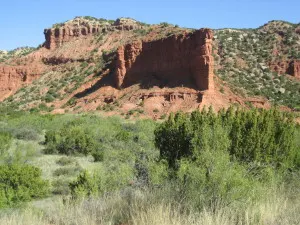
It’s a stunningly beautiful erosion disaster that inspired Georgia O’Keefe to paint western landscapes. It was also the backdrop for the end of the Red River War. Canyons like Palo Duro seem have no business in the Texas panhandle. I certainly didn’t expect to find a second one. But about a hundred miles Southeast of Amarillo near the small Texas town of Quitaque (pronounced Kit-i-kway) there it is—15,314 acres of the most beautiful erosion disaster I’ve ever seen.

Caprock used to be a great place to hunt buffalo. Indigenous people killed thousands of them there starting about 10,000 years ago. That was before horses and even bows

Caprock Canyon

Caprock Canyon

and arrows. Folsom man (named for the Folsom N.M. where their lance points were first discovered) took the animals with spears and atlatls. They also stampeded them over deadfalls. The bison were just as surprised to find canyon in the middle of the grasslands as I was.

The Comanche, the Kiowa, and the Southern Cheyenne moved into the region after horses were introduced by the Spanish. They terrorized the local tribes and were pretty much running things by the time white settlers started moving through the area. The plains Indian era ended when Colonel Ranald (Bad

Caprock Canyon

Caprock Canyon

Hand) Mackenzie recruited the Tonkowa, Ute, and Deleware to help him kill off the plains Indians’ horses and leave them on foot and undersupplied just as winter was setting in. The horse slaughter took place in Palo Duro, but brass cartridges and even artillery shells have been found in several locations in Caprock.

I have to believe Colonel Bad Hand Mackenzie felt bad about killing all those Indian ponies. Ten years after the Red River War he was discharged from the army for “the general paresis of the insane.” Quanah Parker, on the other hand, became the chief of all the Comanche’s on the reservation. He went on hunting trips with

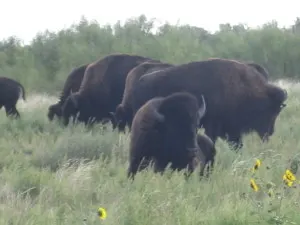
Official Texas Bison Herd

Official Texas Bison Herd

President Teddy Roosevelt and a founded of the Native American Church. While he was busy becoming one of the wealthiest Native Americans of his time, Quanah Parker had time to marry eight wives and have twenty-five children.

I gave many of the Comanche chief’s personality traits to Archie Chatto, Robert Collins and even Hashilli when I wrote Owl Dreams. I used him again in two new novels that will be coming out later this year, Magic Popsicle Sticks, and Trial Separation. I’ve also taken bits and pieces of Rand (Bad Hand)

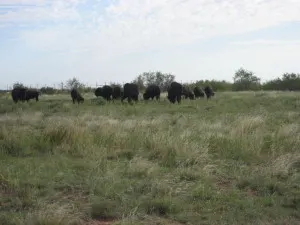
Caprock Buffalo

Caprock Buffalo

Mackenzie’s life—his mental challenges and his physical handicap—for several of my stories. You’ll recognize them now that you know. When I’m borrowing from reality, I like to borrow from the very best.

Buffalo are grazing in the canyon again. In September of 2011, 80 descendants of the original southern plains bison herd were released in a 700 acre protected area of the canyon. No Comanche’s have been seen in he area, but I wouldn’t count them out just yet.


“Girl Crazy”

“Girl Crazy” was published in the Storyteller volume 19, issue 1, January / February / March edition, 2014.

Opening paragraphs:

 Clyde Tombaugh knew an African American couldn’t blend in with the all-white crowd in the KFC, so he stooped behind the salad bar while he decided who was going to buy his lunch.

It didn’t take long. A fat man carried a three-piece chicken dinner to the soft drink station. He put his cup under the Dr. Pepper spigot and held it there until the soda pop sloshed over the rim. No ice, just the way Clyde liked it.

He waited until the man found a table.

“‘Scuse me.” Clyde gave him the look. He pulled his lips back over his teeth, the way a wolf smiles at a rabbit. He took a quick look around to make sure there was no girlfriend. Men did crazy things when a girlfriend was watching. Momma Allison taught him that.

“Girl crazy things,” she told Clyde. “Like sticking around when they ought to run away.”

The fat man was all alone, so Clyde hardened up the look, “Y’all gonna eat that chicken?”

You can check out the Storyteller or order back issues here. 

Pen and Keyboard Writers / Edmond

Not tasty, but it's refreshing.
Not tasty, but it’s refreshing.

When I first tried my hand at writing fiction, I started with a novel. A lot of people make that mistake. I began with a compelling idea, and wrote about it until I ran out of things to say. When I stopped I had a 190,000 words that spent most of their time going nowhere.  I had spent not one minute learning the craft of writing. I’ve still got that novel. Every now and then I take it out and weigh it to remind myself how far a writer can go wrong before he tries something new.

The Pistol That Nearly Killed MeWriter-agent-editor Terry Burns told me what I should do. He told a lot of people while he was lecturing a room full of would be writers at the annual OWFI conference. He said writers should perfect their skills on short fiction.

I had no idea how to write short fiction. But then come to think of it I had no idea how to write a novel either and short fiction had one compelling advantage over novels. They didn’t take so long to write.

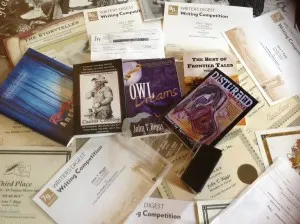
Ten years later I have 45 short stories published in a wide variety of magazines and anthologies. I’ve won some some pretty respectable prizes: Grand Prize 80th annual Writers Digest Competition, Third prize 2011 Lorian Hemingway contest, OWFI Creme de la Creme winner in 2012, Storyteller Magazine’s Peoples Choice Award.

I’ve published a free standing short collection of stories, Southwest Gothic Tales available free on smash words, a Max Avalon single, Messages and a Novel, Owl Dreams, which is based on a character developed in a series of short stories. Pen-L Publishing has two more of my novels in the editing process. They both started off as pieces of short fiction.

Thank you Terry Burns.

On Saturday, April 12, I’m speaking to the Pen and Keyboard Writers of Edmond about writing short fiction and short fiction contests. For those who can’t attend and those who lose their handout, I am going to list a number of useful links here.

Duotrope is a site that offers a weekly newsletter which keeps writers in touch with new markets, old markets that are opening and closing, and contests. If you only have one link at your disposal, this is the one it should be. In the last two years, I have had 40 short stories published  in magazines and anthologies. At least 30 of these have come from Duotrope. This is a subscription site, but it is well worth the $50 per year it costs.

Just a Contest, and Freelance Writers, are two contest sites that charge no money and offer a wide variety of links to contest websites. They are great for this purpose but if you are looking for markets for short fiction they are not the place to go.


Winning stories
Winning stories

Writers Digest and Lorian Hemingway  have well known and well respected contests. I’ve had good experiences with both these sites and actually received a personal letter from Lorian Hemingway.

Writers of the Future is a contest site where many science fiction and fantasy writers have gotten their start. The contest is free. You can enter stories up to 17,000 words long, but you must be an amateur writer.

OWFI offers an annual contest for its members. The cost is exceptionally low and the prizes are worthwhile. I’ve been a winner, a loser, and a judge in this contest. If you are a regional writer you should be a member.

Frontier Tales is an on line magazine of Western Fiction. If your story is published it automatically is eligible for a “The Best Of” contest. Winners in the past have been published in The Best of Frontier Tales anthologies. The site is operated by Duke Pennell, my publisher, and yes, one of my stories won a “Best of” contest.

The Storyteller Magazine is a writers magazine that includes contests but is also a market. Regina Williams is the editor. I have to say she is the friendliest, most open editor I have ever met. She publishes the magazine quarterly, and each issue is loaded with 40 or more stories. Regina will give new writers a chance where many other editors will not.

The Puddle of Genius

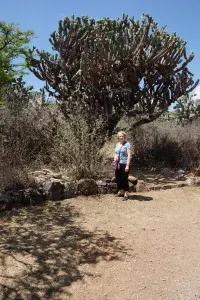
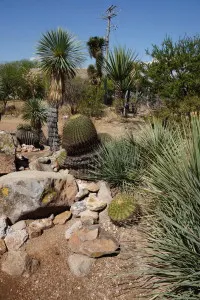
Tree size cholla cactus in El Charco del Ingenio

Tree size cholla cactus in El Charco del Ingenio

A mile or so east of the Parroquia in old San Miguelle de Allende—and up hill all the way—is a high desert botanical garden with the unlikely name of “The Puddle of Genius.” It sounds better in Spanish—El Charco del Ingenio—but then almost everything sounds better in Spanish. The garden / ecological park takes its name from a small pool of water at the bottom of the canyon that had spiritual relevance to the indigenous people.

A beautiful location with a mystical provenance and a funny name—this is exactly the kind of Magic Realism detail I like to put include in my fiction (Owl Dreams, Southwest Gothic Tales, Messages).

Back in the old days, when times were tough holy men would head for The Puddle of Genius and wait for the spirits to send them a brilliant solution to their current problems. People did

Cactus in El Charco Del Ingenio

Cactus in El Charco Del Ingenio

that sort of thing all the time before the Internet. They’d sit in the shade, clear their minds and wait for a supernatural connection. It worked for the indigenous holy men about as well as it worked for the Dalai Lama—no math problems or romantic issues please—and if things didn’t turn out well the thinker could always blame it on a higher power.

Puddle magic blessed me with an epiphany as soon as I reached the garden: “Next time I’ll take a cab.”

That’s the spiritual recommendation if you want to visit El Charco del Ingenio. Taxi’s are easy to find in San Miguel. The fairs are zoned and drivers will take out of shape Americans to from the center of town to the garden for fifty pesos (A little less than four U.S.D.). You’ll feel a lot

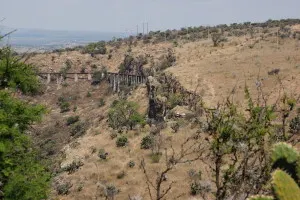
Old Steel Aqueduct in El Charco Del Ingenio

Old Steel Aqueduct in El Charco Del Ingenio

better about the 250 acres of trails if you don’t start off out of breath and it will please the supernatural park rangers.

The botanical garden has historical features as well as native desert plants. Pre-Columbian tools and ceramics have been found in caves scattered through the valley. You’ll see ruins of Spanish colonial buildings overgrown with vegetation. The walls and sluice of an old mill remain along with the

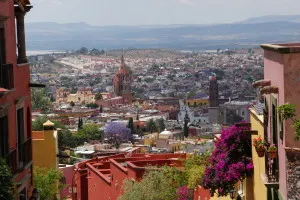
View of San Miguel on the walk back from El Charco Del Ingenio.

View of San Miguel on the walk back from El Charco Del Ingenio.

foundations of a Hacienda, a functional 19th century dam, and the infrastructure for an aqueduct built in the first half of the 20th century.

With all of its antiquities, you’d think the park has been around for a very long time, but it was actually inaugurated in 1991. Like everything in Mexico, the opening was coordinated with an astronomical event—a total eclipse of the sun.

Celebrations of equinoxes and solstices are common at El Charco del Ingenio. They are timed to coincide with similar festivals held in the old part of San Miguel.

My wife (a master gardener and major plant enthusiast) timed our visit after the first serious rain in the month of March, a few days after the equinox. The Jacaranda trees and the cactus were in bloom, the views from the park were gorgeous, and the spirits were free with good advice.