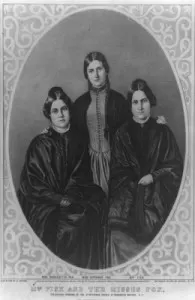
Margaret, Kate and Leah Fox
Things have always gone bump in the night, and when that happens, people usually give a passing thought to the supernatural. Spirits are nothing new. They are found in the oral histories of every culture, in the scary stories children tell during sleepovers, even in the plays of William Shakespeare.
Ghosts (real or imaginary) have always been with us, but the Spiritualist Church got its start in Hydesville, NY on March 31, 1848 when Margaret and Kate Fox (ages 15 and 11 respectively) used “rappings” to convince their much older sister Leah that they were communicating with the spirit of a murdered peddler whose body was hidden in the cellar of the family’s recently acquired home.
There were already rumors the house was haunted. People heard groans, bumps, and even the sounds of furniture being moved. Those sounds might have been attributed to
The National Spiritualist Summit Magazine
settling noises that are common in old houses but when the Fox sisters asked questions, the noises answered—one “rap” for yes and two for no. After an elaborate game of twenty questions, the girls had the foundations of a new religion all laid out.
A lot of religious movements took root in western New York in the early and mid 19th century. These included:
- The Later Day Saints Movement. In claimed he was led by an angel to a hill near his home in Manchester, NY where he found the golden plates that were his source for the Book of Mormon.
- The Millerites. William Miller founded a church based on a vision of the end of the word that would take place on October 22, 1844. That obviously didn’t happen, but many of Miller’s concepts are still held by adherents of Adventism.
- The Shakers were very active in that area, and established their first communal farm in central NY.
- The Oneida Society established a temporary community in the region. They had a unique interpretation of group marriage with mates chosen by committee and children raised in common.
The Fox family was good friends with a radical Quaker couple who helped spread their fame through their religious community. You might be asking yourself, what constituted a radical in the 1840’s? These Quaker extremists believed in abolition of slavery, equal rights for women, and temperance.
 Before long, the Margaret and Kate Fox were the central focus of the Spiritualist Church in America and Great Britain. Their sister Leah spent much of her life managing their careers. The sisters had many notable supporters including: James Fenimore Cooper, Sojourner Truth, Horace Greeley, William Cullen Bryant, George Bancroft, and William Lloyd Garrison. They could have probably maintained a socially respectable following if they hadn’t developed serious drinking problems.
As their alcohol dependency grew worse, Kate and Margaret quarreled with their older sister (and business manager) Leah. They denounced her and confessed that Spiritualism

seance
was a fraud. In 1888, before an audience of 2,000, Margaret showed how she produced “rapping” by popping her toes. She told the crowd, “I am here tonight as one of the founders of Spiritualism to denounce it as an absolute falsehood from beginning to end, as the flimsiest of superstitions, the most wicked blasphemy known to the world.”
A year later she—and her sister Kate—retracted their denouncement and tried to resume their careers. They never regained popularity and died penniless five years later.
The Spiritualist Church did not share the Fox sisters’ demise. It gained popularity in the U.S. after the Civil War and expanded even more in the U.S. and in the UK after WWI. Mary Todd Lincoln conducted séances in the White House. Alfred Conan Doyle (physician and author) joined the Ghost Club (Charles Dickens had been a member before him) and promoted Christian spiritualism.

Site of the Fox Sister’s Cabin
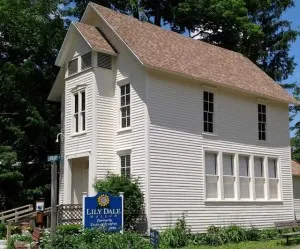
The town of Lily Dale, NY became renowned as a center for American Spiritualism when it purchased Margaret and Kate Fox’s house in 1927 and moved it into the town. The building is gone, but the site is now maintained as a small clearing in the woods where devotees can go to meditate.
Here’s an interesting bit of information for skeptics to consider. In 1904 (long after Margaret and Kate were “in spirit”) a false wall collapsed in the cellar of the Fox’s old home and revealed a man’s skeleton. A peddler’s tin box was also found. Here were two bits of physical evidence supporting the

Peddler’s Box from the Fox’s house
validity of the sisters’ first séance. That box is on display in the Lily Dale Museum, but it isn’t clear what happened to the bones.
Skeptics and devotees of Spiritualism have continued to search for proof or refutation of communication with the dead.
In 1921, Thomas Lynn Bradford of Detroit, Michigan decided the only way to settle the controversy was to commit suicide and communicate an undeniable message through a medium. Unfortunately, the message was not all that undeniable. He told his co-investigator, Ruth Doran, “I am the professor who speaks to you from the Beyond. I have broken through the veil. The help of the living has greatly assisted me.” He had more to say but nothing specific enough to satisfy a non-believer.
 Harry Houdini was a famous spiritualist skeptic of his day. He promised to pass on a very specific message to his wife, Bess, from beyond the grave if such a thing was possible. The message was short, sweet, and specific: “Rosabelle Believe”. After ten years of consulting mediums and attending séances, Bess finally gave up.
By the way, Houdini died on Halloween, in 1926—coincidence?