
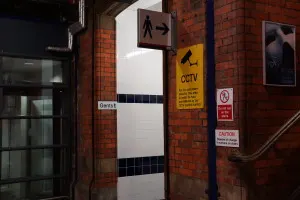
Camera Warning Outside Men’s restroom
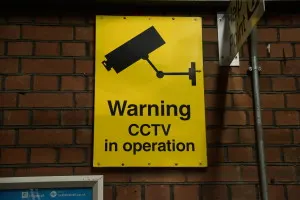
The first time I went inside a public restroom with a sign outside the door that said, “Warning CCTV in operation,” I kind of lost the urge. Surveillance warnings didn’t come as a complete surprise. I’d watched Masterpiece Mystery!, on U.S. public television. I knew CCTV cameras were common in the UK, but until I visited London a couple of weeks ago, I never realized how prevalent they were.
CCTV stands for closed circuit television in case you haven’t heard. The first system was engineered and installed by Siemens AG at Test Stand VII in Peenemünde, Germany in 1942 for observing the launch of V-2 rockets. I doubt the Germans envisioned the technology for storing videos for the police to view days or even weeks after an incident occurred. George Orwell was British after all.
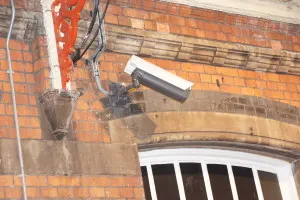
Every Public Place is monitored
Those cameras are everywhere in the United Kingdom. One count puts their number at 1.85 million. That’s about one for every thirty-two people in the country. There are private cameras too—just like in the United States—in banks, restaurants, and shops. The United Kingdom has become a geopolitical version of Las Vegas, only the surveillance doesn’t begin and end at casino doors. It follows visitors and citizens in streets and on the Underground.
There are mounted cameras at intersections that record automobile traffic and others
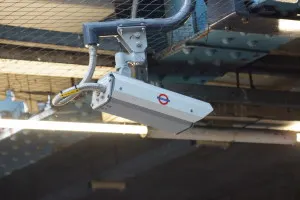
CCTV in the Underground
that document the movement of pedestrians. Video appearances are unavoidable. The average U.K. citizen passes 70 public cameras over the course of the day, and God knows how many private ones. The devices don’t pick up sound, so far, but British law enforcement hires lip readers to help get them over that technological hump.
If you commit a crime in a public place in England, the police will obtain the video files and watch you in the act. CCTV images are better than eyewitnesses at a trial, and the cameras are positioned so a criminal can be followed from the scene to wherever he went afterward.
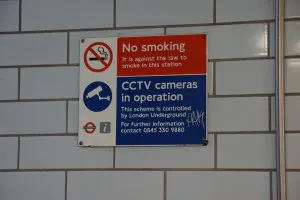
CCTV Warning Sign
It’s not a perfect system, but it’s had a drastic impact. Since CCTV has been universally installed, crimes in parking lots have been reduced by 51%, crimes in public transportation areas have been dropped by 23%, and over the overall crime rate in public areas has decreased by 7%. As you might imagine, crimes against property are reduced substantially more than crimes against people. I couldn’t find any crime statistics dealing specifically with public restrooms, but they’ve probably gone down too.
Once a crime has been committed, the police are less successful using CCTV to catch the offender. Only 1% to 3% of crimes are actually solved using the technology, but in large metropolitan areas that is still a significant number, and the prevention aspect of surveillance is undeniable.
CCTV in Train Station
The British Criminal Justice System devotes 20% of its budget to the technology, so their commitment is not in doubt. So far there have been no nationwide scandals or abuses and the cameras have become ordinary fixtures on the street, as easy to ignore as trash receptacles. Locals don’t seem to pay attention the CCTV cameras and warning signs anymore, but if you visit London, they will definitely catch your eye.